
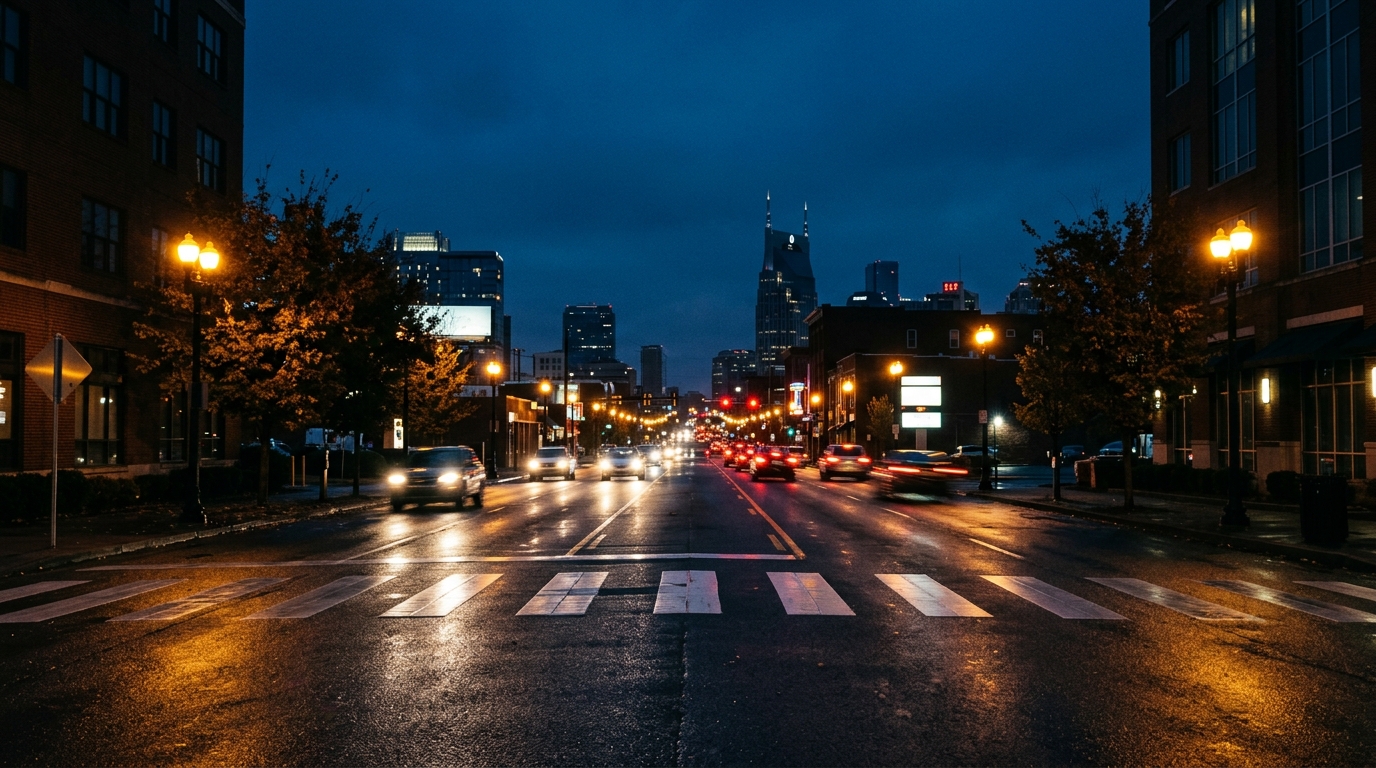
When the Clocks Fall Back: Why Nashville Crashes Turn Deadlier After Dark
David Anthony Smith
Oct 14 2026 13:00
Quick Summary
Daylight saving time ends Sunday, November 1, 2026, moving the evening commute into darkness, where the deadliest crashes happen. DRS Law’s review found that dark-condition crashes account for about 31% of crashes but about 63% of deaths in Davidson County. Lighting and visibility evidence can matter greatly after a serious collision, particularly when an insurance company tries to shift blame to the person who was hurt.
For Nashville and Middle Tennessee commuters, the change can feel minor at first. Yet a familiar drive home at 5 to 7 p.m. suddenly happens in low light, with tired drivers, bright headlights, changing traffic patterns, and people walking, riding, or crossing streets that may not be well lit.
At DRS Law, we have spent more than 40 years helping families after catastrophic injuries and wrongful deaths. Our multi-generational family firm focuses on serious cases, not a high-volume stream of minor crashes, and we understand how quickly a routine drive can become life-changing.
What DRS Law’s Crash Data Shows About Driving After Dark in Nashville
DRS Law analyzed every Metro Nashville crash report since 2021 to better understand how darkness affects safety in Davidson County. The distinction between the number of collisions and the severity of collisions is striking.
Dark-condition crashes made up about 31% of reported crashes, yet they were connected to about 63% of roadway deaths. In other words, crashes after dark may represent a smaller share of total wrecks, but they are far more likely to have devastating consequences.
Over five years, 603 people died on Davidson County roads. Since 2022, annual roadway deaths have ranged from 111 to 138, or roughly one person every three days. Each number represents a person whose family expected them home.
These figures do not mean every nighttime collision is inevitable or that darkness alone causes a crash. They do show why drivers must adjust to conditions and why a careful investigation is essential after a serious wreck. A driver who could see only a short distance ahead, approached too quickly for the available light, or failed to watch for people outside a vehicle may still be responsible for the harm caused.
Why the First Weeks After the Time Change Are the Riskiest
The first weeks after the clocks fall back can create a difficult adjustment period. People leave work, school, appointments, practices, and errands on the same schedules they followed before the time change. The difference is that the 5 to 7 p.m. commute is now darker than many drivers expect.
Visibility changes before a driver fully recognizes it. Dusk can obscure contrast. Headlights from oncoming traffic can create glare. Wet pavement can reflect lights and make lane markings, curbs, and pedestrians harder to distinguish. A driver moving at the same speed used in daylight has less time to identify a hazard, decide what to do, and react safely.
Fatigue can compound those problems. The time change can disrupt sleep, while the end of a workday already finds many commuters mentally tired. Drivers may be rushing to get home, picking up children, checking a navigation app, or simply relying too heavily on a route they travel every day.
Safe driving after dark requires more than turning on headlights. It requires slowing down for the distance a driver can actually see, maintaining a focused lookout, allowing extra space, and recognizing that other road users may be difficult to spot. That responsibility matters on Nashville streets, suburban routes, and the roads Middle Tennessee commuters use to get home.
Who Gets Hurt Most: Pedestrians, Cyclists, and Motorcyclists
People outside passenger vehicles face especially serious risks after dark. Pedestrians are smaller, less protected, and may be partly obscured by shadows, parked vehicles, glare, or roadside clutter. Cyclists can be difficult to detect when a driver is turning, entering a roadway, or approaching an intersection. Motorcyclists may be visible only as a single headlight, which some drivers misjudge in distance or speed.
That does not mean the person walking, riding a bicycle, or operating a motorcycle is automatically at fault. Drivers have an ongoing duty to keep a proper lookout and operate at a safe speed for conditions. A roadway user’s visibility is one fact in an investigation, not a complete answer to who caused a crash.
For someone injured while walking, prompt legal guidance can be particularly important because camera footage and witness recollections can disappear quickly. DRS Law handles serious pedestrian accident claims
and works to identify the full circumstances of a collision, including lighting, sightlines, driver conduct, and available video.
Motorcyclists and bicyclists can also suffer catastrophic injuries in collisions that begin with a driver saying, “I did not see them.” Not seeing another person is not always an excuse. The central question is often whether a reasonably attentive driver, traveling at a safe speed in the same conditions, should have seen the danger in time to avoid it.
“They Were Wearing Dark Clothes”: How Insurers Use Darkness Against Injury Victims
After a night crash, an insurer may focus quickly on clothing, reflectors, where a pedestrian was walking, or whether a cyclist had a light. Those questions may be relevant, but they can also be used to minimize the driver’s own conduct.
Tennessee follows a modified comparative fault rule. In plain language, an injured person may still recover compensation if they were less than 50% at fault. Any recovery is reduced by their assigned percentage of fault. For example, a person found 20% responsible could have damages reduced by 20%. If they are found 50% or more at fault, they generally cannot recover from the other party.
That makes the evidence and the framing of a case important. An insurer’s claim that a pedestrian wore dark clothing does not erase a driver’s duty to watch the road, use appropriate speed, and respond to conditions. The same is true when a driver is distracted, impaired, speeding, or looking into glare without reducing speed.
Our experienced injury attorneys examine the facts rather than accepting a quick blame narrative. You can read more about how comparative fault works in Tennessee, but every serious injury case depends on its specific evidence.
Evidence That Matters After a Night Crash
Nighttime crash investigations often turn on details that may be lost if no one acts promptly. A police report is important, but it may not capture every factor that affected what the driver could see or how they were driving.
Useful evidence may include:
- Photos and video showing the lighting, shadows, roadway layout, weather, signage, and sightlines at roughly the same time of night.
- Footage from nearby businesses, residences, traffic cameras, or other sources, which may overwrite quickly.
- Information about vehicle headlights, taillights, brake lights, and any damaged or inoperative equipment.
- Phone records or vehicle data that may help clarify distraction, speed, braking, or other conduct.
- Witness accounts gathered while memories are still fresh.
Prompt photos are often helpful, but families should never put themselves in danger to collect evidence. If a serious injury prevents someone from acting, a Nashville personal injury attorney can help preserve available information and begin investigating before critical records disappear.
Some cases also involve an unusually dark road, missing illumination, or a hazardous public property condition. Depending on the facts and the responsible entity, that may raise questions under the Governmental Tort Liability Act, often called the GTLA. Claims involving public entities can involve strict notice and procedural rules, so early legal review is especially important.
When a Night Crash Is Fatal
A fatal crash leaves families with urgent practical questions at the same time they are grieving. They may face medical bills, funeral expenses, loss of income, and the painful uncertainty of what happened in the final moments before a collision.
Tennessee wrongful death claims generally have a one-year filing deadline, although deadlines and exceptions can vary based on the facts. Waiting can also make it harder to preserve video, inspect vehicles, identify witnesses, and document roadway conditions. Families should consider speaking with counsel early, even if they are not ready to make every decision at once.
DRS Law approaches these matters with care and thoroughness. Our Nashville wrongful death lawyers
help families understand their legal options and pursue accountability when another person or entity’s negligence caused a preventable loss. We are licensed in Tennessee, Kentucky, and Georgia, with a Nashville office and a Bowling Green office, and we can discuss the circumstances in a way that respects the family’s pace.
Talk With a Nashville Injury Attorney Before the Evidence Fades
After a serious nighttime collision, it is easy for an insurance company to define the story before all the facts are known. Early investigation can help protect the evidence that explains whether lighting, speed, distraction, vehicle condition, or another failure contributed to the crash.
DRS Law has recovered more than $500 million for clients and brings a client-focused approach to catastrophic injury and wrongful death cases. Our office is located at 1913 21st Avenue South, Nashville, TN 37212, and our team serves clients throughout Nashville, Davidson County, Middle Tennessee, and beyond. If you need experienced Nashville car accident lawyers
after a serious crash, we can review what happened and explain your options in a free consultation.
A drive home can change a family’s life in only a few seconds. To speak with DRS Law, call (615) 742-1775 or submit your case through our Submit Your Case page. There is no fee unless we recover for you.