

Court Denies DA Funk’s Motion to Dismiss in First Amendment Lawsuit
Federal Judge Allows Lawsuit by Former Prosecutor to Proceed
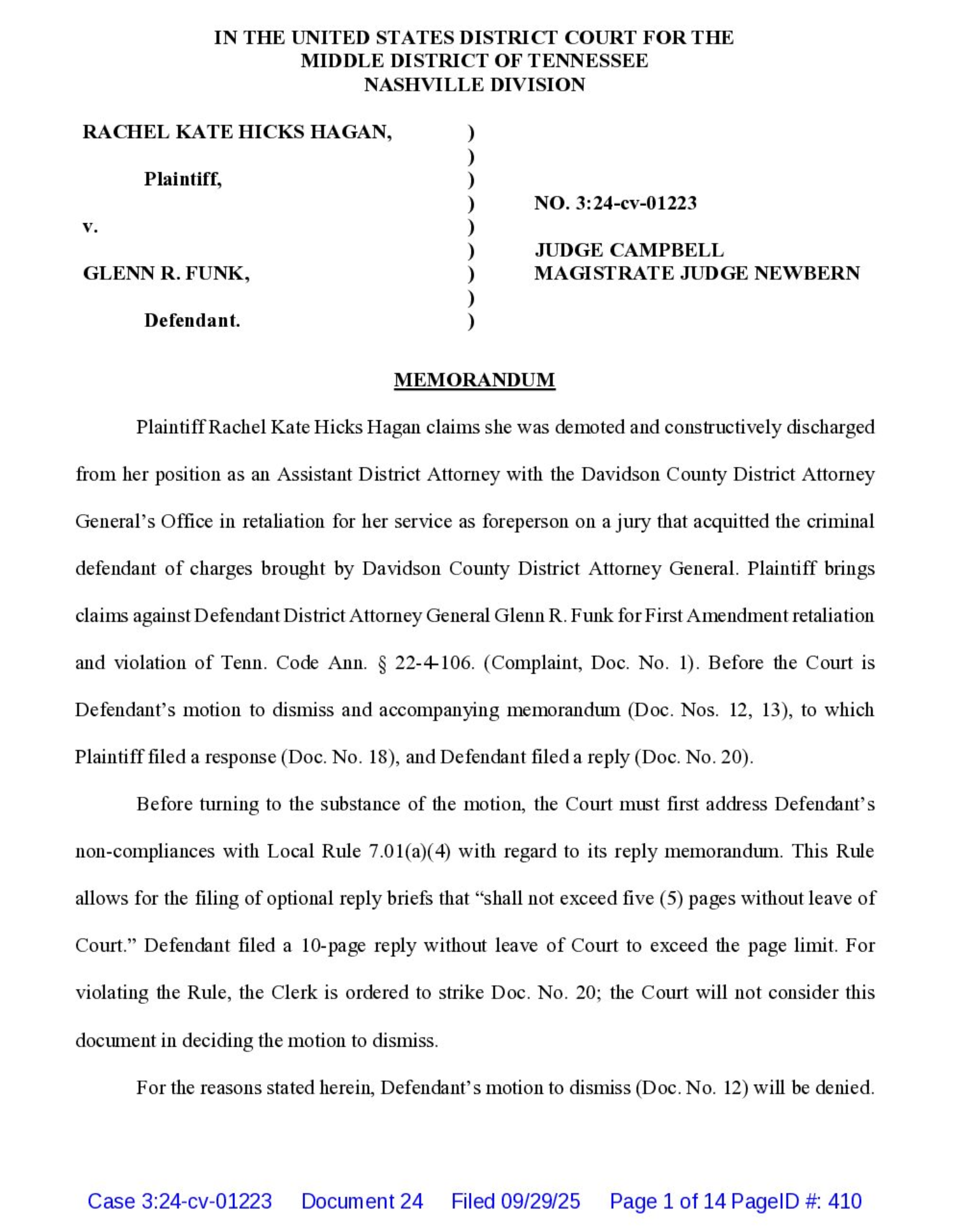
A federal judge has denied a motion to dismiss a civil rights lawsui t filed against Nashville District Attorney Glenn Funk by former Assistant District Attorney (ADA) Katie Hagan. The ruling, issued Monday by Chief U.S. District Judge William L. Campbell, Jr., allows Ms. Hagan’s case, which alleges First Amendment retaliation, to proceed to the next stage.
Background of the Retaliation Allegations
The lawsuit, filed by DRS Law, claims that Funk retaliated against Hagan after she served as the foreperson on a jury that acquitted a defendant in a case prosecuted by Funk’s office. According to court filings, Hagan alleges she was subsequently berated, placed on leave, demoted, and constructively discharged from her position.
The complaint states that Hagan, previously a courtroom prosecutor, was reassigned to review U-Visa applications, a task the lawsuit says does not require a law degree. This action was taken despite the DA’s Office’s own employee manual, which describes jury service as a “responsibility of good citizenship”.
The Court’s Legal Reasoning
In his motion to dismiss, Funk asserted various forms of immunity and argued that his actions were justified. Judge Campbell rejected these arguments for the purposes of a motion to dismiss.
Immunity Arguments Rejected
The court denied Funk’s claims of sovereign, qualified, and absolute prosecutorial immunity at this stage of the litigation. The memorandum stated that claims for injunctive relief against a state official are not barred by sovereign immunity and that personnel decisions are generally not shielded by the absolute immunity granted to prosecutors for their advocacy functions.
First Amendment and State Law Claims Upheld
The Court’s ruling affirmed that Hagan has plausibly alleged a violation of her First Amendment rights. The court’s analysis cited established legal precedent that “a State may not discharge an employee on a basis that infringes that employee’s constitutionally protected interest in freedom of speech”. The court also allowed a related claim under a Tennessee state law that prohibits employer discrimination based on jury service to move forward. The judge also noted that the defense’s arguments were “troubling, to say the least” for mischaracterizing the factual record from the original trial.
Next Steps in the Case
The denial of the motion to dismiss allows the case to proceed into the discovery phase, where both parties will gather evidence and depose witnesses.