
Concussion After a Car Accident: Why a Normal CT Doesn't Rule Out TBI
Christopher Smith
Jul 28 2026 15:10
After a serious crash, insurance companies often rely on two statements to minimize a brain injury claim: “The CT scan was normal,” and “There was no loss of consciousness.” Those facts may matter, but they do not end the conversation.
At DRS Law, we represent accident victims throughout Tennessee, Kentucky, and Georgia who are facing the real-world consequences of catastrophic injuries. A concussion after a car accident can be difficult because its effects may not be obvious in an emergency room—or to an insurance adjuster reviewing a stack of records weeks later.
A Concussion Is a Type of Traumatic Brain Injury
A concussion is a form of mild traumatic brain injury, often called a mild TBI. It can occur when a person’s head strikes an object during a collision, but it can also result from the force of the crash itself. A sudden jolt to the body can cause the head and brain to move rapidly back and forth.
That matters in car accident cases. A person may have no visible wound, no skull fracture, and no documented loss of consciousness, yet still experience meaningful symptoms after the wreck. According to the Centers for Disease Control and Prevention, concussion symptoms can affect the way a person thinks, learns, feels, acts, and sleeps.
For someone living with the injury, the problem is not whether a scan looked normal on the day of the collision. The problem is whether the crash changed how they function at home, at work, in relationships, and in everyday life.
Why a Normal CT Scan Does Not Rule Out a Brain Injury
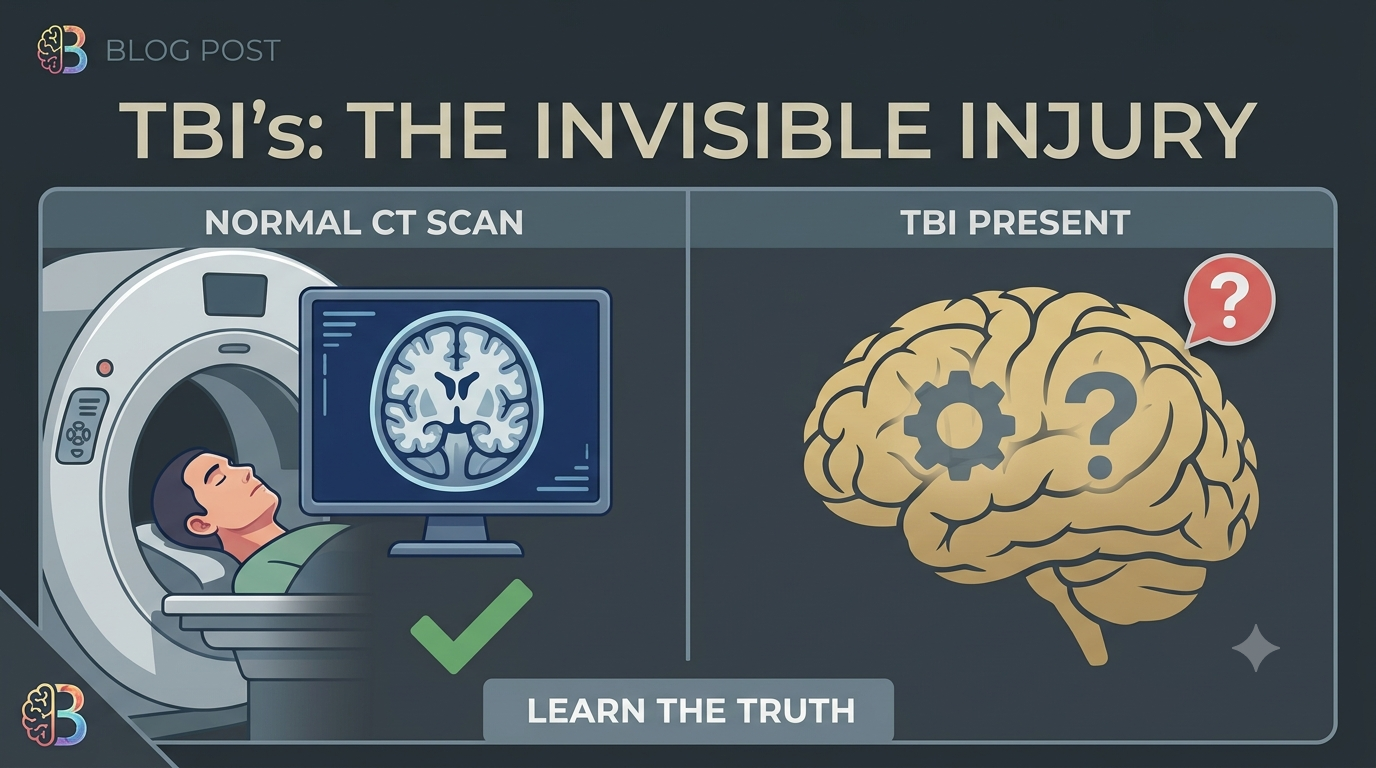
Emergency rooms use CT scans for an essential purpose: identifying urgent conditions that may require immediate intervention, including bleeding in or around the brain. A normal CT can be reassuring in that emergency context. But it is not the same as a finding that there was no concussion.
The CDC specifically explains that a brain scan such as a CT scan is not needed to identify every mild TBI or concussion, although it may be used when a provider is concerned about bleeding after a head injury. In other words, a CT scan and a concussion evaluation answer different questions.
Insurance companies may try to blur that distinction. They may argue that no bleed means no brain injury. But a concussion is often a functional injury: it may show up in the person’s attention, memory, emotional regulation, sleep patterns, tolerance for noise or light, and ability to manage ordinary responsibilities.
Every case is different, and medical providers—not lawyers or insurance adjusters—should determine what testing, referrals, treatment, or follow-up care is appropriate. Advanced imaging may be considered in some circumstances, but no one scan should be treated as the sole measure of whether a person is experiencing legitimate post-accident symptoms.
Loss of Consciousness Is Not the Only Sign of a TBI
Another common defense in a brain injury lawsuit is that the injured person did not lose consciousness. But an absence of documented loss of consciousness does not necessarily mean an absence of injury.
After a crash, first responders may arrive after the most chaotic moments have passed. The injured person may be confused, dazed, distracted by pain, or unable to accurately describe what happened. Medical documentation is critical, but it is created in a fast-moving environment where the immediate priority is identifying and treating urgent conditions.
A concussion after a car accident may still be supported by symptoms that appear immediately or emerge over the following days. The CDC lists headaches, dizziness, light sensitivity, concentration problems, memory issues, irritability, emotional changes, and sleep difficulties among possible mild TBI symptoms. Symptoms can affect thinking, behavior, mood, and sleep, and they vary from person to person.
The Daily Changes Can Become Important Evidence
In a TBI case, the people closest to the injured person may notice changes that do not appear on a single hospital record. A spouse, parent, adult child, coworker, friend, or caregiver may be able to describe how the person functioned before the collision and what changed afterward.
For example, a person who was once patient and even-tempered may become unusually angry or easily frustrated. Someone who was organized and dependable may begin forgetting appointments, losing track of conversations, missing deadlines, or struggling to complete familiar tasks. Sleep problems, impulsive behavior, anxiety, and difficulty making decisions can also interfere with a person’s relationships and work.
These observations are not a substitute for medical care. They can, however, help show the full impact of a brain injury when combined with medical records, symptom reporting, treatment history, work records, and testimony from qualified experts when appropriate.
What to Do If You Suspect a Brain Injury After a Crash
Your health comes first. Seek prompt medical evaluation after a head impact, a violent jolt, or new neurological symptoms. Follow your provider’s recommendations, attend follow-up appointments, and be candid about every symptom—even if it seems minor or embarrassing.
- Keep a daily record of headaches, sleep, memory lapses, dizziness, mood changes, and challenges at work or home.
- Tell your doctor how symptoms affect ordinary tasks, not just how you feel during an appointment.
- Ask family members to note changes they observe in behavior, memory, sleep, and personality.
- Preserve crash reports, photographs, witness information, medical bills, and communications from insurers.
- Avoid giving a recorded statement or accepting a quick settlement before you understand the full extent of your injuries.
Seek emergency care immediately for danger signs such as worsening headaches, repeated vomiting, seizures, weakness, slurred speech, increasing confusion, or difficulty waking the injured person. The CDC provides additional guidance on emergency concussion danger signs.
How a Brain Injury Lawyer Can Help
A brain injury claim requires more than simply stating that someone hit their head. It requires a careful investigation into how the collision occurred, what medical care was needed, how symptoms developed, and how the injury affected the person’s life.
DRS Law approaches these cases with the understanding that a client is more than a CT report or an insurance file number. Our Nashville personal injury attorneys work to develop the evidence needed to present the complete story—not just the insurer’s preferred version of it.
If you or someone you love is dealing with memory problems, sleep disruption, mood changes, or other possible concussion symptoms after a car accident, DRS Law can evaluate your options. We offer a free legal consultation for people seeking answers after serious accidents in Tennessee, Kentucky, and Georgia.
FAQ
Can you have a concussion after a car accident with a normal CT scan?
Yes. A CT scan may be used to assess urgent concerns such as brain bleeding, but a normal CT does not automatically rule out a concussion or mild traumatic brain injury.
Do you have to lose consciousness to have a TBI?
No. Loss of consciousness can occur after a brain injury, but it is not required for a concussion or mild TBI. A healthcare provider should evaluate symptoms and determine appropriate care.
What symptoms should I watch for after hitting my head in a crash?
Possible symptoms include headache, dizziness, nausea, memory difficulties, concentration problems, irritability, sleep disruption, sensitivity to light or noise, and feeling foggy or slowed down.
Why do family members matter in a brain injury lawsuit?
Family members and caregivers may be able to explain changes in personality, memory, behavior, sleep, and daily functioning that help demonstrate the injury’s real-life impact.
When should I speak with a brain injury lawyer?
Consider speaking with an attorney as soon as possible when a crash caused a head injury, symptoms are ongoing, medical care is extensive, or an insurance company is minimizing the seriousness of the claim.